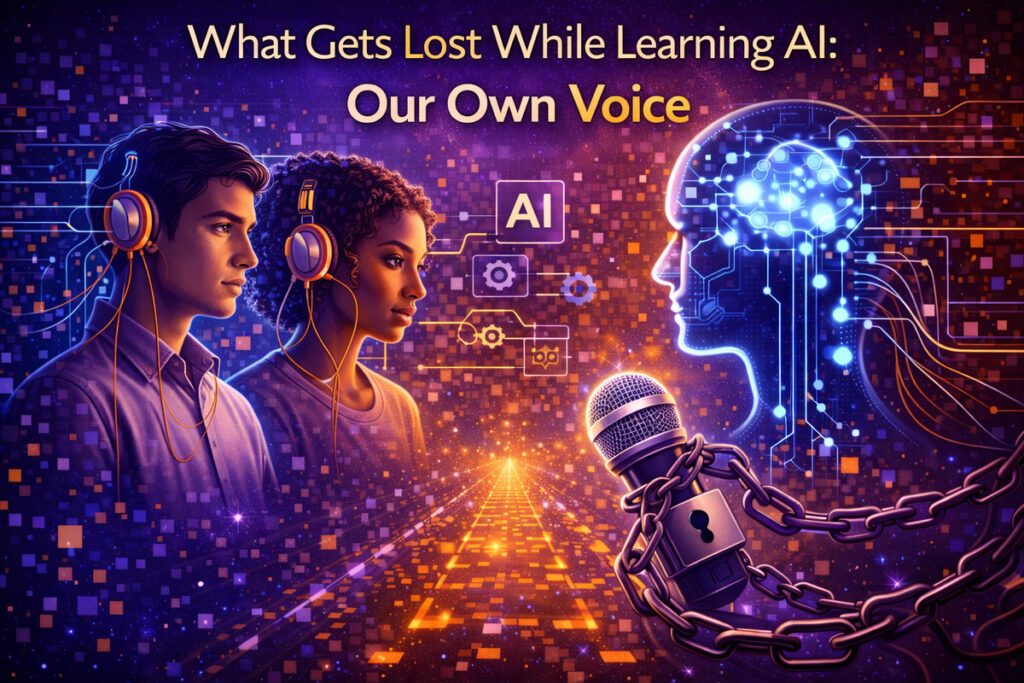

Learning artificial intelligence often begins with a promise of speed for most people. Producing more in less time, thinking more clearly, achieving more effective results… AI tools truly make this possible. However, there is a deep but hard to notice risk along this journey: losing our own voice. As technology advances, many people unknowingly begin to ask themselves, Is this output really mine?
This question touches on the most critical yet least discussed aspect of learning AI. In this article, let’s explore this topic together. Additional details are available at The Blue Whale AI Academy.
Imitation Is Easy, Ownership Is Hard
Those who are new to working with AI usually rely on ready-made patterns. The best prompt examples, the most commonly used templates, lists like write it this way to get better results… These are helpful at first. But when this approach continues for too long, the things being produced start to resemble each other.
Texts are polished but soulless. Ideas are correct but familiar. Sentences flow smoothly, yet it’s unclear who they belong to.
At this point, people unknowingly drift away from their own voice. Because when AI is used like a production machine, the thinking process is handed over to it as well. Yet the real value lies not in the quality of the final result, but in the thinking path that leads to it.
Speed Pressure Silences the Voice
In the age of AI, speed is glorified. Write faster, produce faster, decide faster… This pressure makes it harder for a person to hear their own voice. Because a personal voice takes time. It requires thinking, pausing, and sometimes being uncertain.
AI fills these gaps immediately. A sentence appears before an idea fully forms; a text is completed before a feeling becomes clear. The result looks good, but it doesn’t create inner satisfaction. Because the person shifts from being the subject of the process to merely an observer.
Losing one’s voice often goes unnoticed. The output is still functional. But over time, people stop feeling connected to what they produce. In the long run, this harms creativity and selfconfidence.
When Does AI Become Dangerous?
Artificial intelligence does not become dangerous when it thinks instead of humans, but when humans stop thinking. When we position AI as write for me or decide for me, we gradually push our own voice into the background.
This is especially noticeable among content creators, managers, and those working in creative fields. Because AI is very good at producing an average. But what is personal is never average. What is personal is sometimes incomplete, sometimes rough, sometimes unexpected. And that is exactly where one’s own voice is born.
Where Does the Voice Get Lost?
The moment one’s voice is lost is usually this:When the question Is this output good? is asked instead of Does this output belong to me?
If a person focuses only on performance and does not question meaning, AIgenerated outputs multiply rapidly while personal traces fade away. Over time, one realizes: I’m just editing, but I’m not thinking. At this point, learning AI increases productivity but weakens identity.
Is It Possible to Protect Your Own Voice?
Yes. But it requires a conscious approach. The first step is to see AI not as a tool that produces results, but as a partner that clarifies thinking. Instead of asking AI What should I write?, one should start with the question, What do I want to say?
The second step is allowing yourself to slow down. Accepting that you don’t have to produce everything instantly creates space for your own thoughts. AI then helps shape this space instead of filling it.
The third step is selectivity. You don’t have to use every output. Discarding some sentences, rewriting some ideas, or even completely rejecting AI’s suggestionsthese are all part of protecting your own voice.
A Voice Strengthened by AI
Although it may sound paradoxical, when used correctly, AI does not suppress your voice; it makes it clearer. Because when a person knows what they want to say, AI only helps that thought become more precise.
At this point, AI becomes not a tool that imitates, but one that reflects. The person does not shrink; instead, they express themselves more boldly. Because the burden is lighter and the thinking is deeper.
What gets lost while learning AI is not the technology itself, but the connection a person has with their own inner self. For those who can protect their own voice, artificial intelligence is not a threatit is a magnifying glass. But when this connection breaks, even the most advanced tools produce work that feels empty.
The real issue is not how powerful AI is, but how strongly a person can own their own voice. Technologies change, tools evolve. But people who have a voice of their own are the ones who make a difference in every era.
Contributed by GuestPosts.biz